One of the great revelations Ford’s life had been that places were living things like any other. In good times they grew, changed, and evolved. In bad times they faltered, then when left broken and alone they would slipped into decay. For a while in the surety of his youth he had made the mistake of believing that this was a permanent diagnosis for both people and places. As his sophomoric years passed he had come to realize that should a place survive under any circumstances, retaining with it some piece of its true self which once provided it charm it could, it could in time undergo the same final rebirth offered to all things in their autumn years. When, vested with the countless memories of generations, even their faults were made hallowed.
This was the sole conclusion on the state of the world Ford had arrived at with any real certainty from his stool at the Old Mohawk Tavern. One of the academics from Ohio State could argue it was not the greatest vantage point from which to make a philosophical declaration. To Ford’s recollection he could think of countless monumental moments made in taverns, from O. Henry writing the Gift of the Magi to the planning of the Boston Tea Party. Let alone the countless other declarations of love, hate, and action which had occurred from similar leather stools over the centuries.
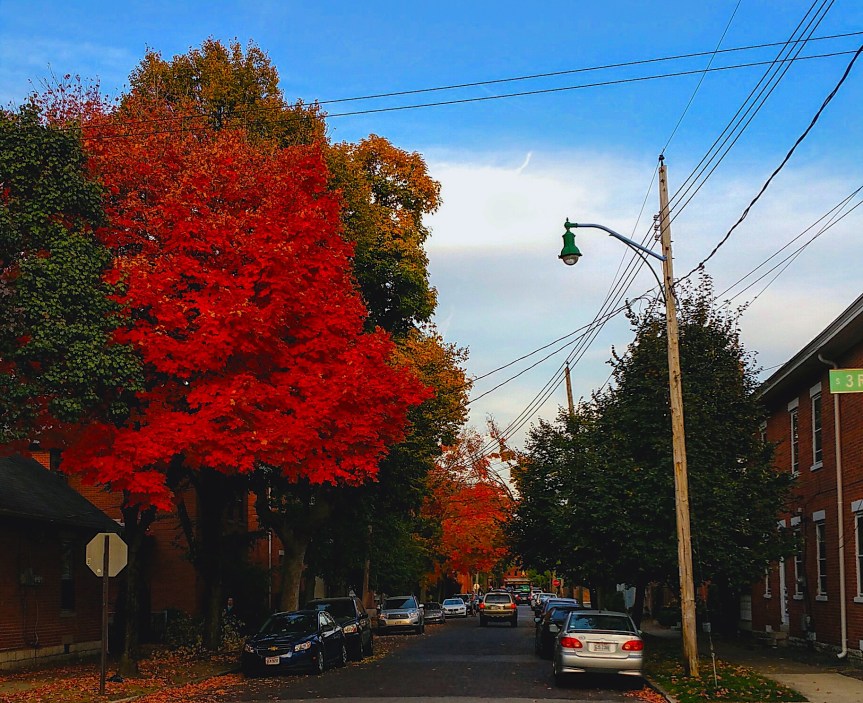
Turning in it, Ford enjoyed the familiar comfort of it’s broken leather cushion. This was truly his stool. Situated on the corner of the bar furthest from the current entrance, which bristled in winter, he could easily see either the TV to his right. Conversely by cocking his head to the left he could look out over the restaurant through the old entrance into the cobblestone street beyond. Today, a bright autumn day where the trees had only just begun to transform into hues of gold and red, the street was at peace. A man walked his dog with his wife, while a family sipped coffee from just down the street on a bench. The scene was familiar to anyone who happened to live in the German Village these days, though Ford had found in his autumn years that it had been those sort of brilliantly mundane moments which affected him the most.
The bartender placed a pint glass down in front of him without being prompted, Ford smiled in appreciation. The two hardly spoke, perhaps because he had never spoken to his predecessor. He turned the pint glass in his hand the head of the amber beer churning in front of him. The Mohawk, and neighborhood, had come a long way since his days as a boy he thought. While the stool itself and the decor had changed since he had first been placed upon a stool by his father on his fourth birthday in 1935. Of course then it still had been Elk’s Tavern with its stories of prohibition and the occasional bottle of moonshine hidden behind the bar.
The Village had been on the decline then, abandoned by the wealth of the city it was well on its way to an industrial slum. By the time he ventured to the Mohawk on his fifteenth to retrieve his father after the war the city had nearly given up on the neighborhood. It’s charms mined for the war, the wrought iron fences had been torn out to make guns. Down the street factories which had churned out armored vehicles sat abandoned, or worse transformed into ghettos for the homeless and refuges for criminals. These charms, like so many of the Village’s good young men, had never returned in peacetime. Those who did, like his father, were often broken, moving forward under their own sheer force of will. Soldiers still on the march. When his father finally found his own peace two decades later the stroke was a blessing.
Ford took a long sip of his beer, then placed it back on the bar. He studied his fingers as they slid over the cool glass. He was older then his father by far, sometime he had never really considered until then. There was a certain immortality around fathers he had found. Ford had noticed, at least in his own experience, that it had only truly been impugned in those final moments at the end. Then when a suitable number of days had passed for the pain to dull to a poignant ache and their actions were confined to the memory, fathers were reborn in either grace or effigy depending on the stories told by their children. Ford pushed the thought from his mind for a moment then and a weathered finger over the smooth gold wedding band.
By the time his father had gone Ford had met his wife and the city had finally decided to save the Village. Frank Fetch with his historical preservation scheme had come under way leaving no corner or alley untouched. The factories were torn down and replaced by new homes serviced by a fresh set of shops which opened up along refurbished old cobble stone roads garnered with crisp black wrought iron fences. The neighborhood, like him and Maureen, possessed the optimism of a generation who had escaped the depression to enjoy the splendor of the American renaissance. They purchased a home was in the village and set to work doing what all young couples in love do. As their kids grew so did the Village it seemed as with every passing year the Garten Club or Historical Association or some other group made massive inroads in transforming the from a slum to a charming haunt. The Mohawk had changed with it too. The dank saloon his father had visited had given way to a friendly neighborhood tavern and he had found himself there with a beer with his own son on the weekends.
Ford’s eyes well at the the thought, mutely he shut them and took a deep breath, letting the pain pass over his heart. It had been a weekend day like that when the accident had come to take Maureen. The driver didn’t even pause as he came around the corner of the park cutting the curb. Witnesses said he didn’t break or swerve. A few days later the police arrested a young boy, he claimed he didn’t do it, his friends finally confessed they had been drunk. After it was all over Ford would have thought he couldn’t set foot in a bar, tilla month later on his fiftieth birthday he had found himself on the stool of the Old Mohawk. He opened his eyes to see the barman staring at him with open concern. Ford forced a reassuring grin as he wiped a tear from the corner of his eye. His hand rested on the wood of the bar, he could feel all its predecessors.
Ford had been lucky he admitted to himself. He had people who had cared, friends, neighbors, the Village, they had all tried to rescue him. They were all so kind, it almost didn’t matter. He had been so sure that fate would take him too on those bleak fall days when the clouds turned everything silver. The kids had been the tipping point. Had it not been for them he would have taken up permanent residency there in the autumn of 81. They had drug him back from the brink. They had needed him when he didn’t need himself and wanted to save him when all he wanted to do was drown, so he had let them. In the process he saw how it had been impossible to save his father. In memory of both of them he crossed himself then took another drink.
Life from then on had been different, hard, and beautiful. There was a bitter sweet joy in the triumphs of those years, every moment tinged by a deep melancholy. They were wonderful though, so much happened he couldn’t have dreamt it all. It hadn’t been for another ten years, when the kids were all settled in their own lives, that he had begun his nightly ritual. Dinner followed by a constitutional to his stool at the tavern, a spot he had failed to yield over the subsequent decades.
“Dad what are you doing here?” The voice pulled Ford from his nostalgia, his son now a man of his own with boy in tow stood beside him. “Is that a beer?” He laughed.
“Yeah, don’t tell.” He grinned slyly to his grandson who chuckled at the idea.
“Dad what are you doing here? Everyone is at the house for your birthday party. People are already getting rowdy, they are going to want to do toasts and stuff soon.”
“Just a little birthday tradition.” Ford said lifting his tired frame from the stool to scoot one down from the corner. He tapped the freshly empty space with his hand gently. “Come on take a seat lets celebrate a little on our own, I’ll tell you about the first time I came here.”
Roister: to engage in noisy revelry
Author’s Note: 7/365, One week down, even if it was at the wire after a long day. I feel like I am going to be editing this story and revisiting Ford and his world in the weeks to come. The Old Mohawk is an actual restaurant and bar in the German Village Columbus, its history and the history of the village presented played out as depicted. The transition of time and our place in it is one I find interesting, especially when we look at our connections to places and events. Ford being an observer of some of the greatest developments in US history and the rebirth of Columbus, OH but witnessing them through the lens of a bar on his birthday was an interesting concept for me.
 The Flask/Pen
One thought on “Short Stories: Roister”